
T: +86-13758587081
E: longtaiyarn@sina.com
E: longtaiyarn@sina.com
Longtai Textile, Building 58, Yuwang Xincun, Datang Street, Zhuji City, Shaoxing City, Zhejiang Province, China.
Views: 0 Author: Site Editor Publish Time: 2026-09-26 Origin: Site


In B2B textile manufacturing, precise yarn count remains strictly non-negotiable. However, the specifications leaving the spinning mill aren't always the ones arriving on your production floor. Environmental factors like ambient moisture and physical stressors during transit easily alter delicate technical properties. They cause costly deviations in metric count (Nm), English cotton count (Ne), or Denier. Evaluating how suppliers package their products serves as a critical, yet frequently overlooked, step in supply chain risk management.
This guide breaks down the essential export packaging standards required to lock in technical properties from origin to destination. You will learn the hidden risks of compromised shipments and explore the three-tier packaging defense system. We also provide actionable strategies for verifying inbound deliverables. Applying these insights helps you prevent material rejection and maintain smooth manufacturing operations.
Textile mills rely on accurate materials to calibrate their machinery. When transit packaging fails, it directly threatens the consistency of your finished fabrics. We must examine exactly how poor protection translates to major manufacturing disruptions.
Unprotected materials readily absorb ambient humidity during long ocean freight journeys. Natural and blended fibers possess high moisture regain properties. This ambient absorption artificially inflates the product weight before it ever reaches your facility. Consequently, QA teams encounter inaccurate calculations during inbound testing. A batch might test as a heavier count simply because it absorbed excess water weight. This leads to false rejections or incorrect machine settings. You end up fighting specification failures caused entirely by a lack of basic moisture barriers.
Improper packing configurations frequently cause internal cones to collapse under their own weight. Forklift vibrations and tight container stacking apply immense downward pressure on lower cartons. Crushed cones physically alter the tension of the wound threads. This uneven tension directly impacts the feeding process on high-speed knitting or weaving machines. Irregular feeding creates visible fabric defects, including striping, dropped stitches, or uneven pile heights. Maintaining cone geometry is vital for uniform tension release.
Material falling out of tolerance carries heavy financial penalties. The hidden costs compound rapidly on the factory floor. Operators waste hours recalibrating machines to handle varying yarn counts. Delayed production runs stall your entire fulfillment schedule. Higher defect rates lead to scrapped fabrics and wasted labor. Protecting your raw materials through robust packaging eliminates these costly friction points before manufacturing even begins.
Preventing transit damage requires a methodical approach. We recommend implementing a three-tier packaging defense system. Each layer targets a specific environmental or physical threat during global shipping.
Table: Packaging Protection Tier Analysis
| Defense Layer | Primary Function | Recommended Material Standard |
|---|---|---|
| Core Rigidity | Prevents crushing and tension loss | High-density plastic tubes or heavy-duty compressed paper cones |
| Moisture Barrier | Blocks atmospheric humidity | Individual heat-shrink wrapping or sealed Polyethylene (PE) bags |
| Outer Structure | Absorbs impact and supports stacking | 7-ply corrugated cartons with internal cardboard separators |
Evaluating the base level means inspecting the use of high-crush-strength paper or plastic cones. The core must withstand tight winding tensions without warping. Warped cores create slack in the wound package. This slack ruins feeding uniformity later. Plastic tubes often provide better radial crush resistance for heavy synthetic filaments. Heavy-duty paper cones work well for spun blends, provided they feature reinforced bases.
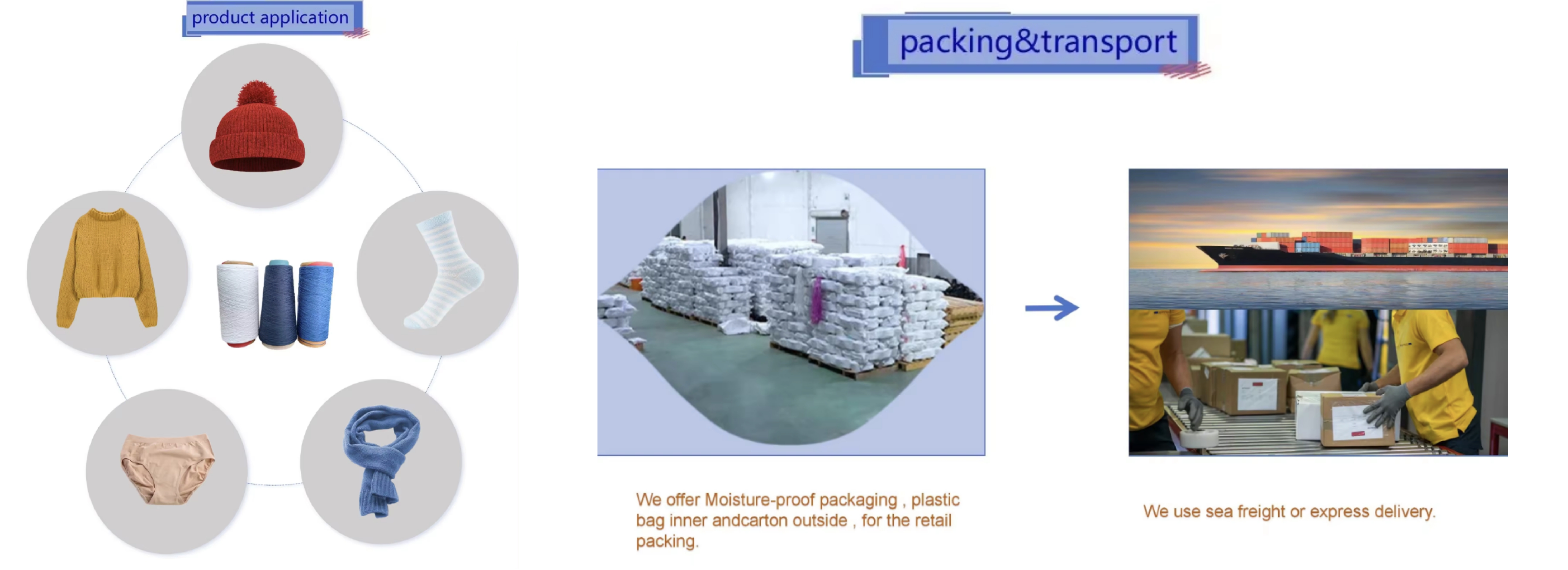
The middle layer determines how well the product resists container humidity. Standard PE (Polyethylene) bags offer baseline protection for short transit routes. However, individual heat-shrink wrapping provides superior defense for long-haul shipping. Shrink wrapping eliminates excess air and forms a skin-tight seal against moisture.
Sensitive fibers demand strict moisture barriers. For example, recycled yarn requires specialized atmospheric protection. Its variable fiber lengths make it highly susceptible to environmental swelling. Without a tight seal, ambient moisture causes these fibers to expand, altering the measured count and weakening tensile strength.
The outermost defense prevents physical trauma. Analyze the corrugated carton configurations used by your vendors. Standard 5-ply cartons may survive short truck routes, but 7-ply export cartons remain mandatory for international sea freight. Internal cardboard separators are equally critical. They prevent adjacent cones from rubbing against one another, eliminating friction damage. Finally, shippers must secure these cartons on properly strapped and stretch-wrapped pallets. Solid palletization prevents individual box shifting during turbulent ocean crossings.
Procurement teams usually focus heavily on sample quality. Yet, a vendor's shipping protocols reveal their true operational maturity. You must assess their export packaging capabilities before signing any long-term contracts.
A reliable yarn count specifications supplier should provide exact data on their packaging methodology upfront. Request their standard carton dimensions, Mullen burst strength test results, and palletization layouts. Transparent vendors willingly share this documentation. If a vendor hesitates to define their packing standards, they likely cut corners on logistics to save money. Establish these parameters as strict contractual obligations.
Look for suppliers who adjust their packaging based on the exact product type. Generic solutions often fail specialized materials. For instance, securing yarn count specifications,premium polyester centipede yarn for socks requires unique handling. Its textured surface and high elasticity present a severe snagging risk during transport. Vendors must utilize specialized anti-friction layering between cones. They should also apply soft-tension winding techniques combined with rigid separators to protect the delicate centipede structure.
Ensure the packaging includes clear, scannable labeling on every carton. Proper labels streamline your inbound receipt process and guarantee traceability. Mandatory label data includes accurate lot numbers, exact metric or imperial counts, gross weight, and net weight. Misinterpreting gross weight for net weight artificially skews your yield calculations. Barcoded labels integrate directly into your warehouse management system, allowing instant verification against purchase orders.
Upgrading packaging standards introduces new logistical variables. Procurement managers must navigate the friction between shipping costs, environmental goals, and material safety.
Heavier, 7-ply cartons and thick plastic separators provide superior crush protection. However, they increase the total freight weight and reduce the number of cones you can fit in a container. This density reduction increases per-unit shipping costs. Buyers must calculate the return on investment of this added freight cost against the historical risk of rejected goods. Spending marginally more on heavy-duty packaging generally prevents massive losses associated with scrapped production runs.
Assess the growing consumer demand for eco-friendly packaging carefully. Brands push suppliers to eliminate plastics. While transitioning to recyclable outer cartons is highly viable, removing internal plastic moisture barriers poses severe risks. Dropping PE bags or shrink wrap on long-haul ocean transit almost always results in specification failures. The material absorbs moisture, degrading its performance. We recommend balancing sustainability by using recycled plastics for the inner barriers rather than eliminating them entirely.
Note how packing requirements shift dramatically based on your chosen transit modality. LCL (Less than Container Load) shipments expose your goods to extreme condensation risks. In LCL, your cargo shares space with unknown goods that might emit high moisture levels. This creates severe container sweat. LCL requires maximum moisture barriers and heavy edge protectors. Conversely, FCL (Full Container Load) shipments allow you to control the internal environment better. You can install desiccants inside the FCL container, slightly reducing the burden on individual carton moisture barriers.
Establishing strict supplier protocols is only half the battle. Your facility must enforce rigorous receiving procedures to ensure those standards are met upon arrival.
The first step of quality assurance isn't testing the actual fibers. It requires inspecting the external shipment integrity. QA teams must check carton corners for crushing, assess pallet wrap tension, and actively look for watermarks. A collapsed carton corner strongly indicates internal cone damage. Identifying this visual evidence allows you to isolate suspicious pallets before they enter the main inventory.
To enforce accountability, you must integrate packaging rules into your purchasing documents. When establishing your baseline yarn count specifications specifications, requirements for the required transit packaging must be explicitly detailed in the final purchase order (PO). Do not leave packing methods up to vendor discretion. Detail the ply count of the boxes, the type of polybag required, and the palletization method. Clear PO documentation empowers you to claim chargebacks if goods arrive damaged due to substandard packing.
We consistently see buyers fail their materials unnecessarily because they test straight out of the box. To get an accurate yarn count specifications measurement, operators must remove the product from its packaging entirely. It must then acclimatize to the testing room's standard atmosphere. Industry standards dictate conditioning the samples at 65% Relative Humidity (RH) and 20°C for a minimum of 24 to 48 hours. This conditioning period normalizes the moisture regain, ensuring your lab equipment measures the true baseline count rather than transit-induced water weight.
A: Packaging doesn't change the physical fiber itself. However, failed packaging allows ambient moisture ingress. This alters the weight and volume of the material. Because count is a relationship between length and weight, this added moisture causes the product to test outside of specified tolerances.
A: At minimum, individual cones must be wrapped in PE bags and placed in 5-ply corrugated cartons featuring internal cardboard dividers. These cartons must be loaded onto fumigated wooden or plastic pallets, properly strapped, and heavily stretch-wrapped to prevent shifting.
A: Yes. Recycled fibers often possess higher moisture regain capabilities and slightly lower tensile strength. This makes them significantly more vulnerable to ambient humidity and physical cone-crushing. They necessitate tighter moisture barriers, like vacuum sealing or shrink-wrapping, to remain stable during transit.