
T: +86-13758587081
E: longtaiyarn@sina.com
E: longtaiyarn@sina.com
Longtai Textile, Building 58, Yuwang Xincun, Datang Street, Zhuji City, Shaoxing City, Zhejiang Province, China.


Fabric l test is whether it returns to shape. Stretch yarn helps textiles expand, recover, and maintain a secure fit. It supports socks, sportswear, waistbands, and many knitted products. This guide explains how it works, where it fits, and how to select it.
● Stretch yarn extends under tension and recovers after the force disappears.
● Many constructions combine an elastic core, such as latex or spandex, with a protective fiber covering.
● The core supplies elasticity. Polyester or nylon improves strength, abrasion resistance, handling, and machine performance.
● Single-covered yarn creates a lighter structure. Double-covered yarn often provides better balance, core protection, and production stability.
● Elongation alone does not prove quality. Recovery, tension consistency, durability, and processing behavior also matter.
● Common uses include socks, hosiery, cuffs, ribs, waistbands, sportswear, gloves, ribbons, and support products.
● The best stretch yarn depends on the fabric structure, machine gauge, elastic zone, finishing process, and required fit.
● Sampling is essential. A controlled trial can reveal breakage, loop defects, exposed cores, or weak recovery before bulk production.
Stretch yarn is engineered to become longer under tension. It then returns partly or fully after release. This behavior helps fabric move, fit closely, and keep its intended shape.
The term covers several structures. Some yarns use an elastomeric core. Others gain stretch from texturing or crimped filament geometry. In many sock and hosiery applications, it refers to covered elastic yarn.
A useful definition includes two actions: extension and recovery. The yarn must lengthen during movement or processing. It must then recover enough to prevent sagging, loose cuffs, or unstable fabric.
A hand pull cannot confirm quality. Compare elongation, recovery, and repeated-cycle performance.
Stretch describes the ability to extend. Elongation measures the increase in length under a stated load. Recovery shows how much original length returns after the load disappears.
High elongation may improve movement but provide weak support. Strong recovery improves shape retention but may feel restrictive. The correct balance depends on the product and elastic zone.
Many covered stretch yarns place latex, rubber, or spandex at the center. This core performs most elastic work. It extends during use, then pulls the textile structure toward its original dimensions.
An elastic core often needs protection. Polyester or nylon can wrap around it and create a stronger working surface. The cover reduces direct friction against needles, guides, and nearby yarns.
Single-covered yarn uses one wrapping layer. It creates a lighter structure and may suit areas needing moderate support.
Double-covered yarn uses two wrapping layers, often in opposing directions. It can improve balance, protection, abrasion resistance, and high-speed stability.
Stretch yarn can improve fit, movement, shape retention, rib definition, and anti-slip performance. In socks, it helps cuffs stay up. In waistbands, it supports repeated expansion.
Final results also depend on stitch density, yarn placement, tension, finishing temperature, and companion fibers.
Tip: Define the required elastic force for each fabric zone before requesting samples.
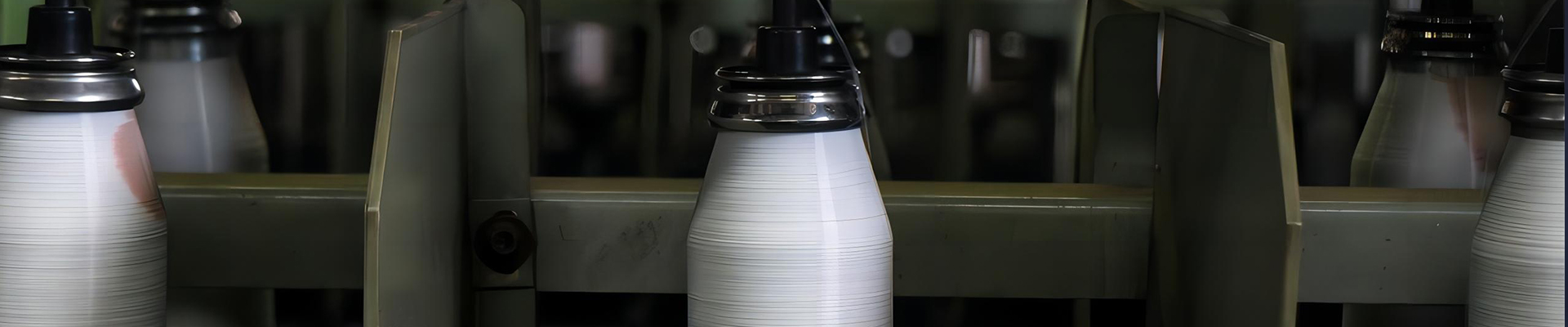
Covered stretch yarn production requires controlled core feeding, wrapping, winding, and inspection. Small setting changes may affect recovery, balance, and machine behavior.
The elastic core must feed at a stable rate and tension. Uneven feeding may create variable stretch, irregular ribs, or inconsistent fabric pressure.
Core size and draft also affect performance. Manufacturers should select them according to the final fabric, not one general formula.
During mechanical covering, polyester or nylon rotates around an extended core. Covering direction, twist, and tension influence surface smoothness, protection, and elasticity.
One stage creates single-covered yarn. A second stage creates double-covered yarn and may improve structural balance.
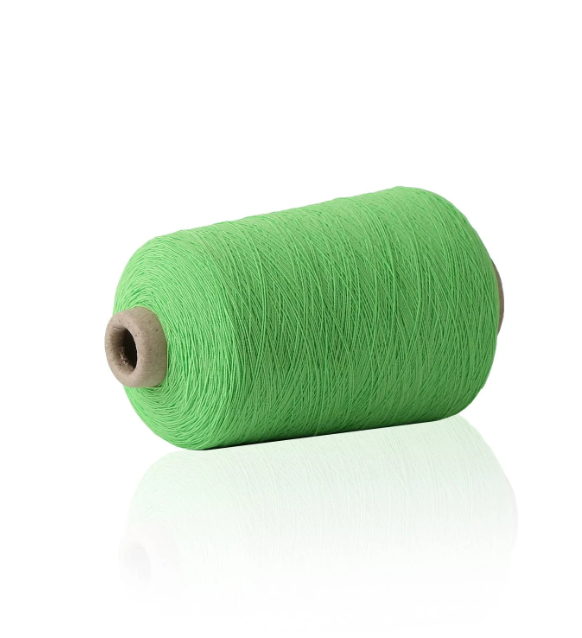
The finished yarn is wound onto cones or spools. Uniform packages support predictable unwinding. Poor winding may cause snarls, tension jumps, broken ends, or machine stops.
Useful checks include package build, yarn evenness, recovery, tensile behavior, covering consistency, and core exposure.

Stretch yarn types differ mainly by elastic source and covering method.
Rubber-covered yarn commonly uses a latex core plus polyester or nylon wrapping. It provides elastic force and reliable rebound in socks, cuffs, waistbands, gloves, and ribbons.
The cover protects the core during processing and wear. Heat, sunlight, chemicals, and aging may still affect long-term performance.
Spandex-covered yarn uses spandex as the elastic core. It may be mechanically covered, air covered, or combined through another process.
It is common in hosiery, activewear, seamless garments, and shoe fabrics.
Air-covered yarn uses compressed air to intermingle elastic and covering filaments. It can offer softness, bulk, and efficient production.
Mechanically covered yarn uses a defined spiral wrap. It provides controlled coverage and strong core protection. Single and double versions allow different balances of weight, feel, and durability.
Textured yarn gains stretch from crimped filament geometry rather than a separate elastic core. It may add softness, bulk, and moderate mechanical stretch.
It is not a direct replacement for every elastomeric yarn. Buyers should compare recovery and holding force in the finished fabric.
Stretch yarn type | Elastic source | Main advantage | Common use |
Rubber-covered yarn | Latex or rubber core | Strong rebound and secure hold | Socks, ribs, waistbands |
Spandex-covered yarn | Spandex core | Controlled garment stretch | Hosiery and activewear |
Air-covered yarn | Intermingled elastic construction | Softness and processing efficiency | Flexible knitted fabrics |
Textured stretch yarn | Crimped filament structure | Bulk and moderate stretch | Comfort knits |
A useful specification should connect yarn properties to the required fabric result.
Elongation shows available extension. Recovery shows whether the yarn returns after stretching. Both need defined test conditions.
Repeated-cycle testing can reveal permanent growth or reduced holding force. It predicts performance better than one pull.
Covered yarn faces friction during feeding, knitting, washing, and wear. The outer filament should protect the core and resist surface damage.
Polyester or nylon coverings can improve durability.
Stable tension supports even loops, consistent rib depth, and uniform elastic force. Variation may create tight bands, loose sections, exposed cores, or visible defects.
Review winding quality, package density, yarn evenness, and performance at the intended production speed.
Elastic materials react differently to heat, chemicals, sunlight, and storage. High temperatures may weaken recovery or change fabric dimensions.
Confirm dyeing, washing, drying, and heat-setting conditions during trials.
Socks need stretch for dressing and movement. They also need recovery to remain close to the foot and leg.
Stretch yarn often appears in cuffs, ribs, ankle zones, and selected body sections.
These areas face frequent extension and must return without becoming loose. Covered elastic yarn provides holding force while its outer layer protects the core.
Manufacturers can adjust performance through yarn placement, stitch density, and feeding tension.
Sportswear needs movement and shape stability. Stretch yarn supports close fit in leggings, socks, tops, and flexible accessories.
Support products require controlled pressure. Final pressure depends on yarn force, fabric structure, product size, and body shape. The complete product needs validation.
Gloves use elasticity for fit and hand movement. Ribbons and tapes need repeated extension without fast deformation.
The selection process should begin with the finished product. “High stretch” alone is not a useful specification.
State where the yarn will appear. A sock cuff, garment body, narrow ribbon, and support band need different behavior.
Define the target result as gentle flexibility, anti-slip hold, firm recovery, or controlled pressure.
Choose the core according to rebound, feel, heat exposure, and end use. Select a cover compatible with the fabric and process.
Review abrasion resistance, dyeing needs, color, surface feel, and core coverage.
Share the machine type, gauge, needle setup, production speed, feeding method, and fabric density. These details support better recommendations.
Also confirm package format and winding consistency.
Run samples on the intended machine using planned yarns, tensions, speeds, and finishing conditions.
Check loop formation, breaks, exposed cores, fabric width, recovery, comfort, and appearance. Finish or wash the sample, then repeat measurements.
Stretch yarn combines controlled extension, reliable recovery, and stable processing. Its core creates elasticity, while the cover improves strength, comfort, and abrasion resistance. Longtai supplies covered rubber yarn for socks, cuffs, waistbands, gloves, ribbons, and related textiles. Its customization, sampling, controlled winding, and export support help manufacturers achieve consistent elastic performance.
A: Stretch yarn extends under tension and recovers after release.
A: Stretch yarn may use an elastic core plus a fiber cover.
A: It improves fit, recovery, and anti-slip support.
A: Price varies by core, cover, construction, color, and volume.
A: Stretch yarn usually provides stronger recovery and holding force.
A: Heat, weak recovery, poor tension, or unsuitable construction may cause it.