T: +86-13758587081
E: longtaiyarn@sina.com
E: longtaiyarn@sina.com
Longtai Textile, Building 58, Yuwang Xincun, Datang Street, Zhuji City, Shaoxing City, Zhejiang Province, China.
Views: 0 Author: Site Editor Publish Time: 2026-07-30 Origin: Site


Balancing fabric hand-feel, durability, and production costs is a continuous challenge in mid-weight textile manufacturing today. Production teams constantly seek reliable materials combining high performance and aesthetic appeal. In this competitive space, "32s" (Ne 32) operates as a highly versatile, medium-fine English cotton count. It flawlessly bridges the gap between lightweight summer apparel and robust household goods. Whether you operate high-speed circular knitters or sophisticated air-jet looms, selecting the correct yarn fundamentally dictates your final fabric quality. This guide aims to help procurement managers and textile engineers carefully evaluate their raw material choices. You will discover exactly how these synthetic fibers perform under intense machinery tension and during complex dyeing processes. Ultimately, we will help you determine if 32s spun polyester stands as the correct technical specification for your upcoming production runs.
Versatility: 32s spun polyester yarn is the industry standard for medium-weight fabrics, functioning effectively as both an apparel knitting yarn and a durable weaving yarn.
Cotton Alternative: The "spun" manufacturing process mimics the natural, soft hand-feel of cotton while maintaining the high tensile strength and shrink-resistance of synthetic fibers.
Material Grades: Sourcing "white virgin polyester yarn" ensures optimal, uniform dyeability, whereas recycled variants offer compliance with sustainability targets at the cost of potential dye-lot variance.
Sourcing Risk: Evaluating yarn based on twist multiplier (TM), evenness (neps/slubs), and tensile strength is critical to minimizing machine downtime during knitting or weaving.
Understanding the exact specifications of your raw materials prevents costly production errors. We measure yarn fineness using the Ne, or English Count system. The Ne measurement represents the number of 840-yard hanks required to weigh exactly one pound. Therefore, a higher number indicates a finer thread. At 32s, the material achieves a highly desirable medium-fine thickness. Fabrics woven or knitted from this specific count are neither overly sheer nor excessively heavy. It creates an ideal medium-weight drape for everyday use.
You must clearly distinguish between spun and filament varieties during sourcing. Filament polyester consists of long, continuous extruded plastic strands. These unbroken filaments feel incredibly smooth, shiny, and somewhat synthetic. Spun polyester takes a radically different manufacturing approach. Manufacturers deliberately cut these continuous synthetic filaments into short staple fibers. These cuts usually match standard cotton staple lengths ranging from 32mm to 38mm. Next, specialized machinery twists these short fibers together using traditional spinning methods. This vital spinning process mimics the natural, breathable texture of cotton perfectly. You receive a highly comfortable hand-feel alongside immense synthetic durability.
Twist Multiplier (TM) serves as another paramount technical specification. The required twist level changes dramatically based on your specific manufacturing end goal. Knitting operations typically demand a lower TM. A softer twist allows the thread to bend easily into interlocking loops without snapping or creating stiff garments. Conversely, weaving requires a significantly higher TM. Modern high-speed loom operations expose warp threads to severe longitudinal tension and abrasive friction. A tighter twist binds the staple fibers securely together. This tight binding increases overall tensile strength and sharply reduces yarn breakage during weaving.
Industry professionals rely heavily on 32s polyester yarn across diverse manufacturing sectors. The fiber provides unmatched adaptability across different automated production lines.
Factories globally deploy this fiber as an everyday apparel knitting yarn.
Use cases: Everyday T-shirts, lightweight activewear, and comfortable base-layer undergarments.
Why it fits: Standard 24-gauge to 28-gauge circular knitting machines require highly flexible materials. This yarn provides the necessary elasticity and soft hand-feel. It creates inherently comfortable garments for direct skin contact. Furthermore, it resists mechanical pilling much better than lower-count synthetic alternatives. The finer 32s count ensures a visibly smoother fabric surface after finishing.
Socks and athletic wear demand highly durable materials. This specification acts as an excellent hosiery yarn for continuous friction environments.
Use cases: Everyday casual socks, athletic hosiery, and performance footwear liners.
Why it fits: Hosiery faces constant abrasion against shoes and floors. This spun variant delivers exceptional abrasion resistance and strong moisture-wicking properties. Manufacturers often plate the base thread with spandex. They also frequently blend it with natural cotton fibers. These specialized combinations maximize stretch, breathability, and shape retention over countless consumer wash cycles.
Durability and color retention take center stage in household goods. As a robust home textile yarn, it drastically outperforms many natural alternatives.
Use cases: Crisp bed sheets, lightweight window curtains, and sturdy upholstery backing.
Why it fits: Household textiles endure rigorous industrial and home laundering. This material offers superior wash-fastness compared to pure cotton. It resists shrinking and wrinkling naturally. The exceptional dimensional stability extends the usable lifespan of home goods significantly. Consumers appreciate the low-maintenance, iron-free finish it provides to large fabric panels.
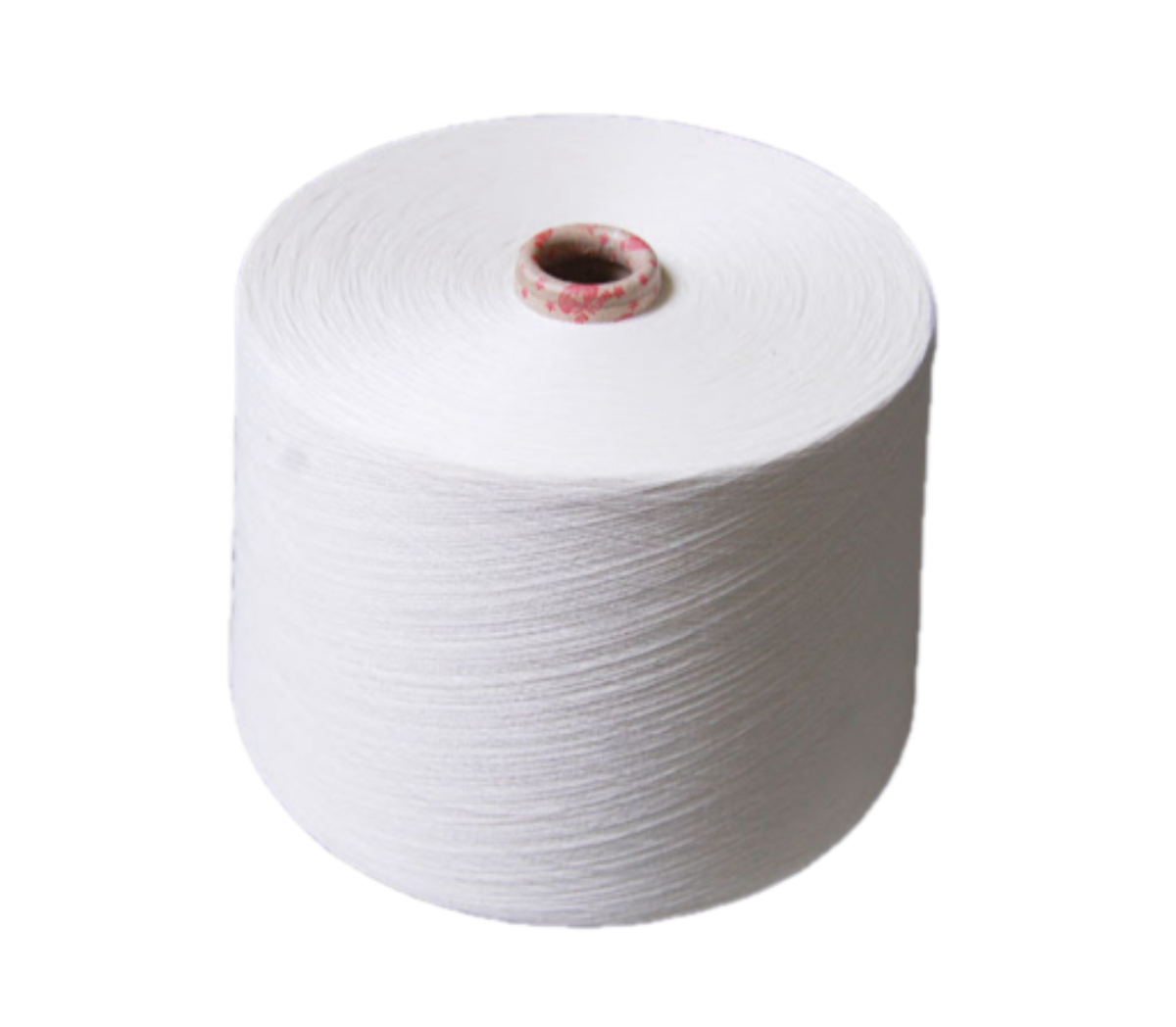
Choosing between virgin and recycled raw materials heavily impacts your final product yield. Production teams must carefully weigh strict visual requirements against corporate sustainability targets.
The business case for white virgin polyester yarn rests on absolute physical consistency. Opting for virgin fibers is strictly required for critical color-matching tasks. If your production line involves optical whites or bright pastels, pure virgin materials ensure brilliant dye uptake. They completely lack the muddy undertones often found in secondary materials. Additionally, virgin material provides peak structural integrity. Automated, high-speed looms require flawless tension control. Virgin spun variants maintain a phenomenally lower defect rate. You will experience fewer neps and minimized surface hairiness. This purity drastically reduces unexpected loom stops and fabric grading downgrades.
Alternatively, evaluating recycled (rPET) 32s yarn addresses rapidly growing consumer demand for eco-friendly textiles. Sourcing Global Recycled Standard (GRS) certified yarn helps modern brands meet strict sustainability targets. However, manufacturing teams must clearly understand the associated trade-offs. Recycled fibers undergo multiple aggressive heat and mechanical cycles during initial processing. This recycling stress can cause minor limitations in overall tensile strength. You might also encounter slight visual inconsistencies in the base color of the raw yarn. These variations heavily complicate light-shade piece-dyeing. Dye-lot variance remains a common hurdle. Procurement teams should smartly reserve rPET materials primarily for medium or dark dye shades to mask these inconsistencies.
You need strict technical evaluation protocols to guarantee smooth production runs. Assessing yarn quality accurately prevents costly machine downtime and prevents catastrophic fabric defects.
First, verify the Tensile Strength and Count Strength Product (CSP). Modern weaving and knitting machinery operates at immense, unforgiving speeds. The yarn must constantly withstand sudden tension spikes. A high CSP ensures the fiber will not suffer from frequent snapping. You should routinely request updated lab testing certificates from your suppliers. Confirming tensile parameters prevents widespread production delays.
Second, carefully check the supply for evenness and physical imperfections. You must review Uster statistics or equivalent independent lab reports. These optical metrics reveal the exact frequency of thick places, thin places, and neps per kilometer. A high defect rate translates directly into highly visible fabric faults. Excessive neps create small, dye-resistant dots on finished garments. Thin places lead to weak spots and potential fabric tearing during garment assembly.
Finally, thoroughly consider the spinning technology used during manufacturing. The spinning method heavily dictates both material cost and final texture.
Spinning Technology | Key Characteristics | Best Used For | Cost Profile |
|---|---|---|---|
Ring-Spun | Higher overall strength, softer hand-feel, minimal surface hairiness. | Premium apparel, sensitive fine-gauge knitting. | Higher |
Open-End (OE) | High dimensional uniformity, slightly harsher texture, bulkier feel. | Heavy-duty home textiles, utility backing fabrics. | Lower |
Ring-spun methods align perfectly with high-end garment manufacturing requirements. Open-end processes offer an incredibly economical path for utility fabrics. You should choose OE spinning when ultimate softness matters less than bulk production speed.
Securing reliable 32s spun polyester yarn demands sharp supply chain management. Production delays and costly quality disputes often stem from poor procurement strategies.
Navigating Minimum Order Quantities (MOQs) and production lead times stands as your first major priority. You must perfectly align internal order volumes with external supplier capabilities. Custom dye lots naturally demand higher MOQs and significantly extended production windows. Conversely, purchasing raw white yarn for piece-dyeing later offers greater scheduling flexibility and much shorter lead times.
Next, consider the hidden risks of purchasing discounted stock lots versus commissioning fresh production. Buying discounted warehouse stock lots may initially appear financially attractive. However, older inventory frequently suffers from highly inconsistent moisture regain. Standard polyester maintains a moisture regain of around 0.4%. Poor warehouse storage severely alters this metric. You might also accidentally receive mixed batches from completely different production runs. Mixing batches invariably causes severe dye banding or shade variation in the final fabric. Commissioning fresh, continuous runs eliminates these shade inconsistencies entirely.
To actively mitigate these procurement risks, always follow a strict sample testing protocol. Always mandate technical laboratory verification before scaling up your orders.
Request Samples: Ask the supplier for one to two cones of the exact required specification.
Test Strength: Run the sample through tension meters to verify the supplier's CSP claims.
Verify Twist: Ensure the Twist Multiplier perfectly matches your specific knitting or weaving requirement.
Check Dye Uptake: Perform a standard lab-dip dye test. Monitor color uniformity and absorption rates carefully.
Approve the Batch: Only commit to a full container-load order after the sample confidently passes all internal lab tests.
By strictly following this testing protocol, procurement teams shield themselves from large-scale manufacturing failures.
In conclusion, 32s spun polyester offers an optimal balance of daily durability, cost-efficiency, and cotton-like texture. It safely remains the gold standard for mid-weight applications across global apparel and home goods markets. Its unique capacity to withstand high-speed machinery while retaining excellent color fastness makes it incredibly valuable.
Before finalizing your next purchase order, encourage your sourcing teams to clearly define their specific end-use. Clarify immediately whether the upcoming project requires knitting or weaving specifications. Confirm your exact dyeing requirements by choosing deliberately between virgin and recycled raw materials. Once your technical parameters are fully outlined, immediately request updated technical data sheets (TDS) from your trusted suppliers.
A: Yes, it is highly common. Blending usually occurs at the spinning stage, resulting in popular variations like 65/35 poly-cotton. Alternatively, mills can knit or weave pure polyester and cotton threads together on the machine. Blending perfectly balances the low cost and high strength of synthetic fibers with the natural breathability and softness of cotton.
A: The primary difference lies directly in the twist per inch (TPI) or twist multiplier. Weaving operations require a higher twist. This creates a stronger, tighter thread capable of withstanding heavy warp tension on high-speed looms. Knitting operations require a lower twist, which keeps the fiber soft and flexible for smooth loop formation.
A: Spun polyester can pill due to short staple fibers naturally migrating to the fabric surface. However, high-quality spinning techniques and proper staple lengths significantly reduce this risk. Additionally, textile mills routinely apply specific anti-pilling chemical finishes during the final dyeing process to keep the fabric surface smooth over time.