
T: +86-13758587081
E: longtaiyarn@sina.com
E: longtaiyarn@sina.com
Longtai Textile, Building 58, Yuwang Xincun, Datang Street, Zhuji City, Shaoxing City, Zhejiang Province, China.
Views: 0 Author: Site Editor Publish Time: 2026-09-22 Origin: Site


Knitting manufacturers constantly face a difficult balancing act. You need optimal tension for your garments. Achieving this without sacrificing machine efficiency remains critical.
Selecting the exact specification of polyester rubber yarn dictates material expenses, production speed, and final product quality. We specifically look at two major specifications: 90#7575 and 100#7575. These options dominate automated knitting floors worldwide. Choosing the wrong specification often leads to costly trial-and-error runs on the factory floor.
We offer a clear, technical evaluation framework below. You will discover how to evaluate core thickness, retraction force, and yield economies. This guide empowers you to choose the correct material right from the start without second-guessing your production setup.
Nomenclature: The numbers represent core thickness (90# vs. 100#) and covering yarn denier (75D/75D polyester).
Core Distinction: 90# offers higher tension and grip, while 100# provides a higher yield per kilogram and softer stretch.
Application: 90#7575 is the industry standard for heavy-duty sock cuffs and safety gloves; 100#7575 is optimized for standard daily wear and cost-efficient high-volume production.
Cost Factor: Yield-to-weight ratios make 100# cheaper per knitted unit, but 90# reduces structural failure in high-stress applications.
Understanding yarn terminology prevents costly procurement mistakes. The numbers assigned to these materials denote precise physical properties. They dictate how the material behaves under tension.
Natural latex rubber thread uses a unique gauge system. In this system, a higher number indicates a thinner core. Manufacturers determine this number by counting how many threads fit side-by-side within a standard measurement unit. Therefore, a 100# core is physically thinner and lighter than a 90# core. A thicker 90# core inherently stores more kinetic energy. It snaps back with greater force when stretched. Conversely, the finer 100# core offers a gentler, more forgiving stretch profile.
The "7575" metric represents the protective outer layer. It signifies Double Covered Yarn (DCY). Two distinct layers of 75 Denier (75D) polyester wrap around the central latex core. The inner layer wraps in one direction, typically an S-twist. The outer layer wraps in the opposite direction, known as a Z-twist. This dual-directional wrapping keeps the core perfectly balanced. It prevents the yarn from curling onto itself during the feeding process.
Combining a specific tension latex core with a double polyester cover creates a highly resilient material. This forms a premium polyester covered rubber yarn. The polyester shell takes the brunt of the friction generated by fast-moving knitting needles. It protects the sensitive latex inside. This synergy ensures high tenacity. It guarantees uninterrupted runs on automated knitting machinery.
Choosing between these two options requires understanding their distinct physical traits. You must weigh tension needs against economic yield.
Performance Metric |
90#7575 Specification |
100#7575 Specification |
|---|---|---|
Core Thickness |
Thicker (90 gauge) |
Thinner (100 gauge) |
Retraction Force |
High rebound, firm grip |
Moderate rebound, softer stretch |
Yield per Kilogram |
Lower meterage per kg |
Higher meterage per kg |
Primary Benefit |
Maximum structural hold |
Optimized unit economy and comfort |
Tension defines the end-user experience. The 90# specification delivers superior rebound. It grips the wearer firmly. The hand-feel leans toward stiffness due to the robust core. It holds heavy fabrics in place securely. On the other hand, the 100# specification provides a moderate rebound. It stretches smoothly across the skin. This makes it exceptional for comfort-focused garments where excessive compression feels undesirable.
Length-to-weight ratios dramatically alter production economics. Because the 100# core is thinner, one kilogram of this yarn contains significantly more linear meters than a kilogram of 90#. This metric directly impacts wholesale purchasing calculations. When you knit a standard garment, the thinner core consumes less weight per unit. This mathematical reality lowers per-unit material expenses. It allows high-volume producers to stretch their inventory further.
Core thickness plays a pivotal role in longevity. Industrial washing cycles and high-heat drying break down natural latex over time. Ultraviolet (UV) exposure also causes degradation. The thicker 90# core possesses more mass. It withstands these harsh conditions longer before losing its elasticity. Both specifications benefit immensely from the 7575 double covering. The tight polyester shell acts as a barrier. It shields the latex from direct chemical exposure during dyeing and washing.
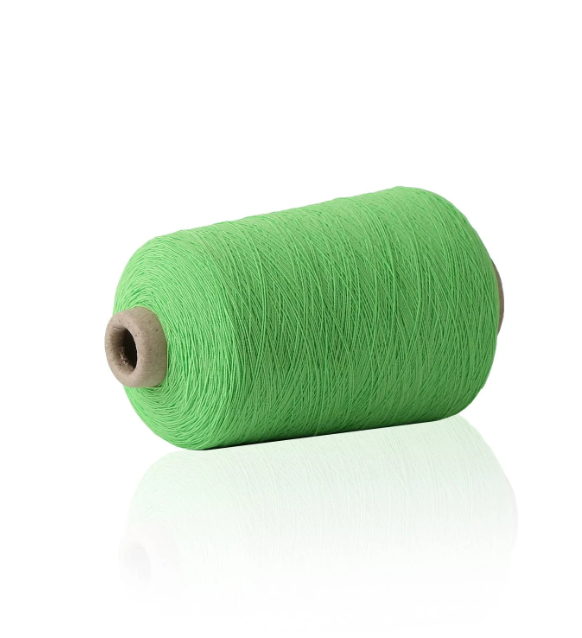
Matching the technical specification to the final product determines your manufacturing success. Certain garments demand aggressive hold, while others prioritize sheer comfort.
You should select the 90# variant for heavy-duty applications. These products demand high grip and steadfast structure. It serves as an exceptional sock cuff yarn for athletic footwear. Compression wear relies heavily on its firm retraction. Industrial safety gloves also utilize this specification around the wrist area.
Success criteria for this application include zero slip during vigorous physical activity. The garment must exhibit maximum snap-back. It needs to maintain this tension over a long lifecycle, surviving hundreds of rigorous wash cycles without sagging.
You should specify the 100# variant for lightweight to mid-weight knits. It acts as the perfect elastic yarn for socks designed for casual, everyday use. Lightweight knitted fabrics and comfort apparel integrate this yarn seamlessly.
Success criteria here look very different. The garment must offer soft skin contact. You want sufficient but non-restrictive elasticity. Furthermore, hitting stringent unit economy goals remains critical. The higher yield per kilogram ensures optimal cost efficiency per knitted unit.
Procuring reliable rubber covered yarn requires strict quality control. Visual inspections alone rarely uncover deeper structural flaws. You must establish rigorous evaluation metrics.
Assess Material Quality of the Core: You must differentiate between premium natural latex rubber thread and cheaper synthetic alternatives. Natural latex generally offers superior snap-back. Assess the high-tenacity properties by pulling a sample to its breaking point.
Check Covering Consistency: Uneven double-covering exposes the bare core. When exposed latex hits a high-speed knitting needle, it causes immediate friction. The thread snaps, causing costly machine downtime. Inspect bobbins closely to ensure the 7575 wrap completely conceals the core.
Evaluate Dyeing and Color Fastness: Black and dyed variations require strict batch testing. You must evaluate color consistency across multiple cones. Test the material for bleeding resistance. It must survive standard manufacturing wash cycles without transferring dye to lighter companion yarns.
Test Elongation Rates: Establish baseline stretch metrics. Every knitting machine operates at specific tension limits. Ensure the yarn elongates uniformly. Inconsistent elongation leads to misshapen garments and irregular sizing.
Moving from a product concept to full-scale manufacturing carries inherent risks. Implementing a new yarn specification requires careful staging and robust supply chain management.
You must never skip the pilot testing phase. Always run a minimum order quantity (MOQ) sample before committing to bulk. Thread the sample through your specific gauge knitting machines. Run it at full operational speed. This reveals the actual breakage rates. It also confirms tension consistency across a continuous run. Theoretical specifications on paper mean very little if the yarn snags on your specific equipment.
Scaling up introduces new variables. Sourcing reliable RCY yarn at volume demands strategic planning. You must factor in extended lead times. Batch-to-batch consistency becomes your primary concern when working with direct manufacturers. Request conformity certificates for each new shipment. This ensures the 90# or 100# core thickness remains identical to your initial approved sample.
Proper warehousing preserves material integrity. Natural latex degrades under poor environmental conditions.
Temperature Control: Store inventory in climate-controlled environments. Extreme heat accelerates core degradation.
Humidity Management: Keep humidity levels moderate. Excessive moisture damages the polyester covering, while excessive dryness causes the latex to become brittle.
Light Protection: Block direct sunlight entirely. UV rays break down latex molecules rapidly.
Stock Rotation: Implement strict First-In, First-Out (FIFO) inventory protocols. This prevents tension loss and dry-rot prior to knitting.
The decision between 90#7575 and 100#7575 represents a calculated trade-off. You must balance aggressive tension strength against favorable yield economy. The 90# variant delivers unmatched durability and grip for heavy-duty applications. The 100# variant champions soft comfort and impressive unit efficiency for high-volume basics.
We highly recommend starting your procurement journey with a thorough technical specification sheet review. Always request a physical sample run. Thread it through your machines before securing bulk container orders. Take the time to consult directly with suppliers. Matching your specific machinery gauge and exact end-product requirements to the right yarn profile guarantees a flawless manufacturing run.
A: Rubber cores provide a higher snap-back force and a much firmer grip. Spandex provides softer, higher elongation stretch. Rubber excels in heavy-duty longevity and structural hold, making it ideal for cuffs. Spandex works better for full-body garments requiring gentle stretch and softer skin contact.
A: Yes, it works well for casual daily socks requiring a softer hold. However, it has limits. Athletic footwear, compression wear, or heavy-duty industrial socks require the stronger grip and superior durability of a thicker 90# core to prevent slipping.
A: Double covered yarn uses two overlapping layers of polyester wrapped in opposite directions. Single covered yarn uses only one layer. The double cover fully encases the core. This protects it from needle friction during high-speed knitting and significantly extends the garment's lifespan.
A: Minimum order quantities typically range between 500kg to 1000kg, depending on the manufacturer and custom dye requirements. However, you should always request a smaller pilot sample first. Running a test batch proves machine compatibility before you commit to large volumes.