T: +86-13758587081
E: longtaiyarn@sina.com
E: longtaiyarn@sina.com
Longtai Textile, Building 58, Yuwang Xincun, Datang Street, Zhuji City, Shaoxing City, Zhejiang Province, China.
Views: 0 Author: Site Editor Publish Time: 2026-08-14 Origin: Site


For textile manufacturers and procurement teams, selecting the right air covered yarn dictates the final fabric's stretch recovery, tactile properties, and overall production yield. You need reliable material combinations to ensure optimal fabric behavior. Sourcing is rarely a one-size-fits-all process. The performance of ACY yarn relies entirely on the precise mechanical synergy between the elastomeric core and the rigid outer filament during the intermingling process. Mismatched components frequently cause costly manufacturing delays.
This guide provides a technical framework for evaluating core and cover materials. We will cover how to manage production risks effectively. You will learn to select optimal specifications for your specific end-use applications. We explore denier configurations, tension dynamics, and key quality indicators. Mastering these elements allows you to build highly functional, durable textile products.
Performance Reliance: The quality of an air jet covered yarn depends heavily on the compatibility of the core's draft ratio and the cover's texture.
Material Selection: Polyester spandex yarn offers cost-efficiency and durability, while nylon spandex yarn provides superior softness and dyeability for premium segments.
Risk Mitigation: Evaluating suppliers requires testing for intermingling stability (nips per meter) and consistent air pressure controls to prevent exposed cores and fabric defects.
Application Specificity: Denier combinations must be tailored to the product, such as utilizing specific 20D/70D ratios when sourcing elastic yarn for socks versus seamless activewear.
Selecting mismatched core and cover parameters directly impacts profit margins. Incompatible yarns lead to uneven dyeing. They also cause poor elasticity and trigger high breakage rates during knitting or weaving. When fibers break, looms and knitting machines stop. These frequent machine stoppages ruin daily production targets. Manufacturers must understand the interaction between elastomeric engines and outer filaments to prevent these outcomes.
Unlike mechanical covering methods, the air jet interlacing process operates differently. It relies entirely on highly compressed air to interlace the rigid filament around the drafted spandex. This means friction levels, operational tension, and material characteristics of both components must align perfectly. You cannot simply force two random filaments together. The air nodes (nips) must effectively trap the stretched spandex inside the textured sheath. If the tension shifts unexpectedly, the core exposes itself.
A successful sourcing decision balances multiple critical variables. You must achieve the required fabric hand-feel. You also need to target a specific stretch modulus. Finally, you must maintain your target cost-per-kilogram. You achieve these goals without ever sacrificing operational runability. Balancing these factors requires a deep understanding of denier ratios and machine drafting parameters.
The polyurethane core acts as the absolute engine of the yarn. It dictates elongation properties, recovery power, and long-term dimensional stability. The outer filament simply protects this core and provides the desired surface texture. Therefore, your core selection sets the baseline for the entire fabric's physical performance.
Standard specifications vary strictly by the intended end use. You must select the right core denier carefully.
20D to 40D Cores: These represent the most common core deniers for everyday apparel. They provide comfortable, lightweight stretch suitable for t-shirts, activewear, and intimate garments.
Heavy Deniers (70D+): Manufacturers reserve these thick cores for high-compression medical textiles. They also use them in heavy woven fabrics requiring robust shape retention.
Fine Deniers (10D to 15D): Used exclusively for ultra-sheer hosiery. These delicate cores demand highly specialized, low-tension manufacturing environments.
Draft ratio considerations play a pivotal role in final yarn behavior. A higher draft ratio essentially pulls the spandex tighter before interlacing. This yields greater stretch potential but results in a thinner overall yarn. It also generates significantly higher internal tension. Procurement teams must rigorously verify supplier draft consistency. If draft ratios fluctuate across different yarn cones, your knitted fabric will exhibit inconsistent widths. We always recommend setting strict draft tolerance limits in your initial specification sheets.
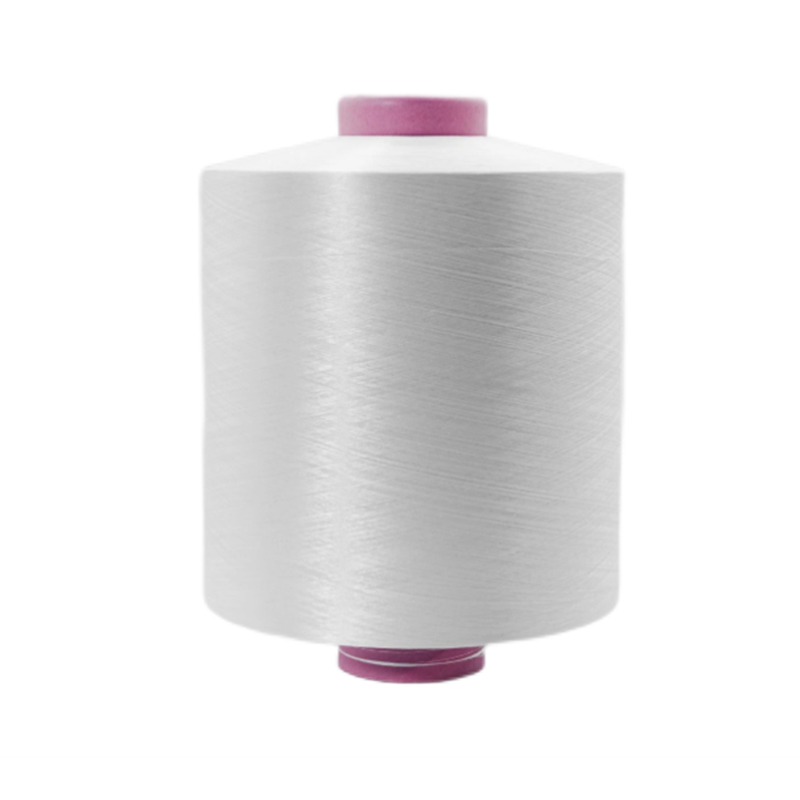
The outer cover dictates how the final fabric feels against the skin. It also controls how the fabric absorbs dye and resists abrasion. Your two primary choices involve nylon and polyester filaments. Each material offers distinct chemical and physical advantages.
Nylon spandex yarn represents the premium choice in the textile sector. It boasts a noticeably softer hand-feel compared to polyester. It provides excellent moisture management properties and features exceptional abrasion resistance. Facilities dye nylon using acid dyes. This chemical process is optimal for achieving bright, vibrant, and highly saturated colors. Consequently, designers typically specify nylon for premium activewear, luxury intimate apparel, and high-end hosiery.
Polyester spandex yarn serves as the highly cost-effective alternative. It delivers high tensile strength and outstanding wrinkle resistance. It also benefits from a structurally lower raw material cost. Dyeing polyester requires disperse dyes operated at much higher temperatures. While it feels slightly less soft than nylon, modern texturizing techniques have narrowed this gap. It remains the best choice for denim fabrics, fast-fashion knits, and standard promotional sportswear.
You should base your decision strictly on the target consumer's price sensitivity. You must also consider the required fabric finishing processes.
Feature | Nylon Spandex Yarn | Polyester Spandex Yarn |
|---|---|---|
Tactile Feel | Exceptionally soft, smooth | Slightly firmer, highly textured |
Dye Compatibility | Acid dyes (lower temperature) | Disperse dyes (high temperature) |
Abrasion Resistance | Excellent | Good |
Moisture Management | High absorption rate | Hydrophobic (quick dry) |
Ideal Application | Premium activewear, lingerie | Denim, standard sportswear |
Pairing the correct core denier with the appropriate cover denier determines fabric weight. It also impacts opacity and structural integrity. A mismatch here ruins the intended product design. You must align these ratios to standard industry applications.
Apparel and Seamless Wear: This category generally utilizes much finer counts. A common pairing involves a 20D spandex core covered by a 30D or 40D nylon filament. This specific ratio delivers lightweight comfort. It ensures moderate stretch perfect for garments worn directly against the skin.
Hosiery and Footwear: Sourcing durable elastic yarn for socks requires robust, high-recovery combinations. Manufacturers typically rely on a 20D or 40D spandex core paired with a 75D polyester cover. This heavier cover withstands high friction inside shoes. It also survives repeated, aggressive washing cycles without degrading.
Woven Fabrics (Denim/Twill): Heavy woven structures demand significantly heavier cover yarns. You will often see a 40D spandex core wrapped in a 150D polyester outer shell. The thick cover protects the fragile core from immense weaving tensions. It also shields the spandex from harsh finishing treatments like stone washing or bleaching.
Understanding these standard industry matrices saves immense trial-and-error time. Always communicate your intended machine gauge to your yarn supplier. Knitting on a fine 32-gauge machine requires vastly different denier ratios than weaving on a heavy rapier loom.
Sourcing raw materials requires strict quality control protocols. Air jet covered yarn production is highly sensitive to environmental and mechanical changes. You must establish clear metrics before confirming bulk orders.
Intermingling consistency stands as the most critical quality metric. Technicians measure this in "nips per meter" (NPM). Nips are the tiny physical nodes where compressed air tangles the outer cover around the core. Ask suppliers for their network point testing data. Too few nips lead to severe core exposure during fabric stretching. Conversely, too many nips cause a harsh, rigid hand-feel. You must find the optimal nip frequency for your specific fabric design.
Air pressure stability represents another major manufacturing risk. Fluctuations in factory air pressure during the interlacing process result in uneven yarn tension. This creates "tight and loose" sections along the yarn cone. When you dye fabrics made from uneven yarn, horizontal stripes appear. Industry professionals call this the barré effect. It ruins entire fabric batches instantly.
Finally, monitor for snapping and breakage risks. Ensure the outer filament possesses adequate tenacity. It must thoroughly protect the core during high-speed circular knitting or rigorous weaving. We recommend running tension tests on sample cones to simulate factory-floor stress levels. If the cover filament breaks early, the bare spandex will snap immediately after.
Moving from technical theory to actual procurement requires a systemic supplier evaluation process. Never purchase bulk yarn without completing rigorous physical testing phases.
Always institute strict sample testing protocols. Request 1-2 kg sample cones from every shortlisted supplier. Conduct a comprehensive knit-down test on your own factory machines. You must check the resulting fabric for spirality issues. Measure the stretch recovery percentage accurately. Verify the surface evenness under strong lighting.
Dyeing tests are equally mandatory. Run sample fabrics through your standard factory dye bath. You need to ensure the core and cover take color evenly. This step remains especially critical when processing dark shades like navy blue or true black. Exposed spandex often flashes white if it fails to absorb the dye correctly.
Do not ignore compliance checks. You should verify international certifications thoroughly. Demand OEKO-TEX Standard 100 documentation to guarantee skin-contact safety. If you are sourcing recycled polyester or nylon covers, require a valid GRS (Global Recycled Standard) certificate. These documents protect your brand reputation.
Your actionable next step involves finalizing a precise technical specification sheet. Document your required Core Denier, Cover Denier, Filament count, and targeted Draft Ratio. Send this comprehensive document alongside your Request for Quotation (RFQ). Clear specifications prevent supplier misunderstandings and streamline the entire procurement timeline.
Choosing the correct air intermingled yarn requires balancing multiple physical properties. You must harmonize the core's elasticity with the cover's protective and tactile characteristics. Understanding the interplay between drafting ratios, denier weights, and interlacing node consistency guarantees better textile outcomes.
While polyester alternatives offer undeniable cost advantages for bulk production, nylon remains the absolute standard for premium performance and comfort. Base your final sourcing decision on verifiable quality metrics rather than upfront price alone. Prioritize nip consistency and factory draft stability. By implementing structured sample testing and rigorous specification sheets, you will secure high-quality materials that elevate your final fabric collections.
A: Air intermingled yarn uses compressed air jets to tangle the outer filament around the spandex core. Mechanically covered yarn physically wraps the cover around the core in a continuous spiral. Air methods produce a softer, bulkier feel and offer a faster, lower-cost production process.
A: A polyester combination, such as 2075 (20D core + 75D cover) or 3075, is best for standard, durable socks. It withstands frequent washing. For premium athletic or dress hosiery, nylon covers provide superior softness and moisture-wicking capabilities.
A: Fluctuating air pressure causes uneven intermingling points (nips). This creates inconsistent tension throughout the cone. During the dyeing process, these tight and loose sections absorb color differently, resulting in visible horizontal stripes known as the barré effect.