T: +86-13758587081
E: longtaiyarn@sina.com
E: longtaiyarn@sina.com
Longtai Textile, Building 58, Yuwang Xincun, Datang Street, Zhuji City, Shaoxing City, Zhejiang Province, China.

Views: 0 Author: Site Editor Publish Time: 2026-08-26 Origin: Site


Sourcing recycled materials introduces inherent variability to your supply chain operations. An ambiguous Request for Quote (RFQ) results in inconsistent production runs. You will likely face machine downtime and severe compliance liabilities. You simply cannot afford vague supplier communications.
Unlike virgin fibers, recycled fibers require strict parameter guardrails. You must balance ambitious sustainability targets against essential mechanical performance. Without precise documentation, manufacturers risk catastrophic production failures. Furthermore, vague claims leave brands vulnerable to greenwashing accusations.
This guide provides a definitive framework for drafting an effective RFQ. We will help you filter out unqualified vendors efficiently. Ultimately, you will learn how to secure technically viable, compliant materials for your product lines.
Treating recycled yarn procurement identical to virgin yarn leads to immediate manufacturing failures. Buyers often assume standard specifications apply universally. They do not. Recycled materials possess distinct structural differences. Shorter staple lengths define mechanically shredded textiles. You must account for these differences upfront.
Failing to adapt your RFQ causes severe implementation realities across the production floor. You will face immediate operational bottlenecks. The financial impact scales rapidly across large orders.
A successful RFQ acts as a legal and technical filter. It demands hard evidence of capability before price negotiations even begin. You eliminate amateur brokers immediately. You only engage experienced manufacturers capable of handling complex secondary raw materials.
Always request historical performance data. Ask suppliers how their recycled yarn performs on modern high-speed looms. Demand specific case studies showing reduced breakage rates.
Transition from generic requests to highly specific engineering requirements. Vague requests invite poor quality. You must dictate exactly what your product needs to survive the manufacturing process.
Define exact percentages of pre-consumer versus post-consumer waste. Post-consumer waste degrades more during recycling. Pre-consumer waste retains better staple length. You must specify the exact ratio.
Specify the carrier fiber used to stabilize the recycled content. Pure recycled cotton lacks sufficient strength for industrial weaving. Manufacturers usually blend it. Common carrier fibers include virgin polyester or organic cotton. You must declare the exact blending percentage to ensure structural integrity.
Mandate the precise spinning technology. Ring-spun, Open End, and Air-jet methods produce vastly different textures. Ring-spun offers softness. Open End provides superior cost-efficiency and durability. The spinning method dictates the final fabric hand-feel.
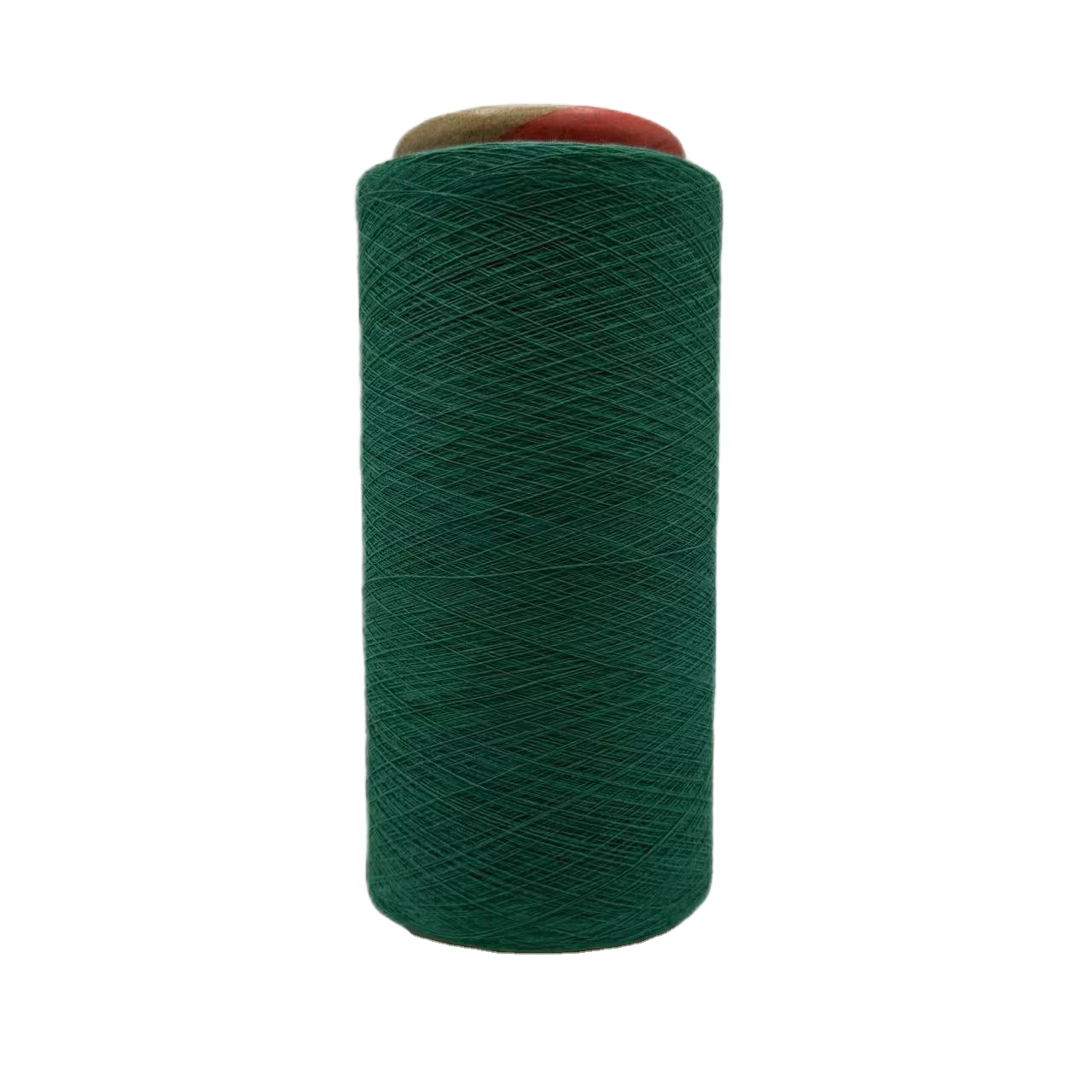
Do not just ask for "cotton yarn" on the RFQ line item. You must specify exact needs. For example, demand oe yarn recycled weaving yarn 12s. This string defines the spinning method, the intended application, and the exact English cotton count.
Mechanical properties determine machine compatibility. High-tension applications demand rigid technical limits.
Establish the minimum breaking tenacity for Tensile Strength (cN/tex). Recycled fibers break easier than virgin equivalents. You must set a firm baseline to keep looms running.
Define the Twist Multiplier (TM or TPM). Specify the twist direction as either S or Z. You must tailor turns per meter based on the end-use. Knitting requires a softer twist. Weaving demands a higher twist multiplier for extra durability.
| Parameter Category | Specific Metric to Define | Why It Matters for Recycled Materials |
|---|---|---|
| Composition | Post-consumer % vs. Carrier Fiber % | Dictates base structural integrity and marketing claims. |
| Spinning Tech | Ring-spun, Open End, Air-jet | Influences final texture, pilling resistance, and cost. |
| Yarn Count | Ne, Nm, or Tex | Determines fabric weight and optimal machine gauge. |
| Twist Direction | S-Twist or Z-Twist (TPM) | Prevents torque-related skewing in knitted garments. |
| Tensile Strength | cN/tex (Breaking Tenacity) | Ensures survival under high-tension weaving environments. |
Acknowledge the inherent nature of secondary raw materials. Recycled fibers naturally possess higher imperfection rates. You must set acceptable, data-backed thresholds rather than demanding absolute perfection. Perfection is impossible here.
Define maximum acceptable limits for common faults. Standard guidelines allow higher defect rates for recycled variants. Typical acceptable increases include Neps (+200%), Thick places (+50%), and Thin places (-50%) compared to virgin baselines.
Request recent testing data from the supplier. Ask for official Uster Tester reports. You need data from their previous batches of similar counts. This proves they actively monitor production quality.
Outlining exact recycled yarn specifications establishes clear expectations early. You avoid costly disputes upon delivery.
Specify exact ISO or AATCC standards for colorfastness. Recycled materials behave unpredictably during washing. Test for colorfastness to washing, rubbing (crocking), and direct light.
Establish acceptable dimensional stability percentages. Shrinkage post-washing ruins finished garments. You must set strict tolerance bands. Typically, a 3% to 5% shrinkage tolerance proves realistic for recycled knits.
Many buyers copy-paste virgin fiber tolerances into recycled RFQs. Suppliers will either ignore the RFQ or lie to win the bid. Always calibrate your testing expectations to the physical realities of shredded fibers.
Mitigate brand risk heavily in this section. You must require non-negotiable proof of origin. Chemical safety remains paramount. Brands face massive legal penalties for false sustainability marketing.
Require Global Recycled Standard (GRS) or Recycled Claim Standard (RCS) certification at the facility level. These frameworks validate the entire chain of custody.
Stipulate the requirement for Transaction Certificates (TCs) with every bulk shipment. Do not accept a one-time Scope Certificate. Scope certificates only prove the facility can produce certified goods. TCs prove your specific batch actually contains certified materials.
Require OEKO-TEX Standard 100 certification. Ensure the recycled feedstocks remain free from banned substances. Shredded post-consumer garments often contain legacy chemicals. You must test for heavy metals and toxic dyes.
Demand complete transparency regarding the dyeing process. Distinguish between dope dyed and piece dyed methods. Dope dyed synthetics save massive amounts of water. You need this data for accurate environmental impact assessments.
You must know how to weigh the RFQ responses accurately. Look beyond the lowest cost per kilogram. Cheap materials often cause expensive manufacturing delays.
Assess the supplier's willingness to provide development samples. Request cone samples before enforcing bulk Minimum Order Quantities (MOQs). A competent manufacturer understands the necessity of trial runs.
Pilot runs reveal hidden quality issues. Run the cone samples through your actual production machines. Monitor the breakage rates closely. Compare the results against the original RFQ promises.
Evaluate the variance between sample lead times and bulk production lead times. Some brokers deliver samples quickly but fail at commercial scale. You need predictable delivery schedules.
Audit their raw material supply chain. Does the supplier own their recycling facility? Are they relying on third-party aggregators? Vertical integration improves price stability. Third-party reliance increases your supply chain risk significantly.
Use a ruthless elimination process. Protect your production timeline.
Vendors who ask clarifying questions about your loom setup usually make the best long-term partners. They understand the engineering challenges ahead.
An effective RFQ bridges the gap between sustainability goals and rigorous manufacturing realities. Precision eliminates assumptions. You protect your production lines by setting strict mechanical and chemical boundaries.
Finalize your technical data sheet using the parameters discussed above. Issue the detailed RFQ to a shortlisted group of three to five certified suppliers. Always initiate a pilot sampling run before committing to a commercial-scale contract. Protect your brand reputation by verifying every single claim.
A: GRS (Global Recycled Standard) includes minimum recycled content percentages (usually 50% for logo use) plus strict social, environmental, and chemical requirements. RCS tracks recycled content accurately but lacks the comprehensive chemical and social auditing found in GRS.
A: Recycled fibers have shorter staple lengths, reducing overall tensile strength. This is why specifying precise twist multiples and breaking tenacity in the RFQ is critical, particularly for high-tension applications like weaving.
A: You must request a Transaction Certificate (TC) from the certification body (e.g., Textile Exchange via Control Union) for your specific purchase order. A general company certificate remains insufficient for batch-level proof.